This article is also available in French.
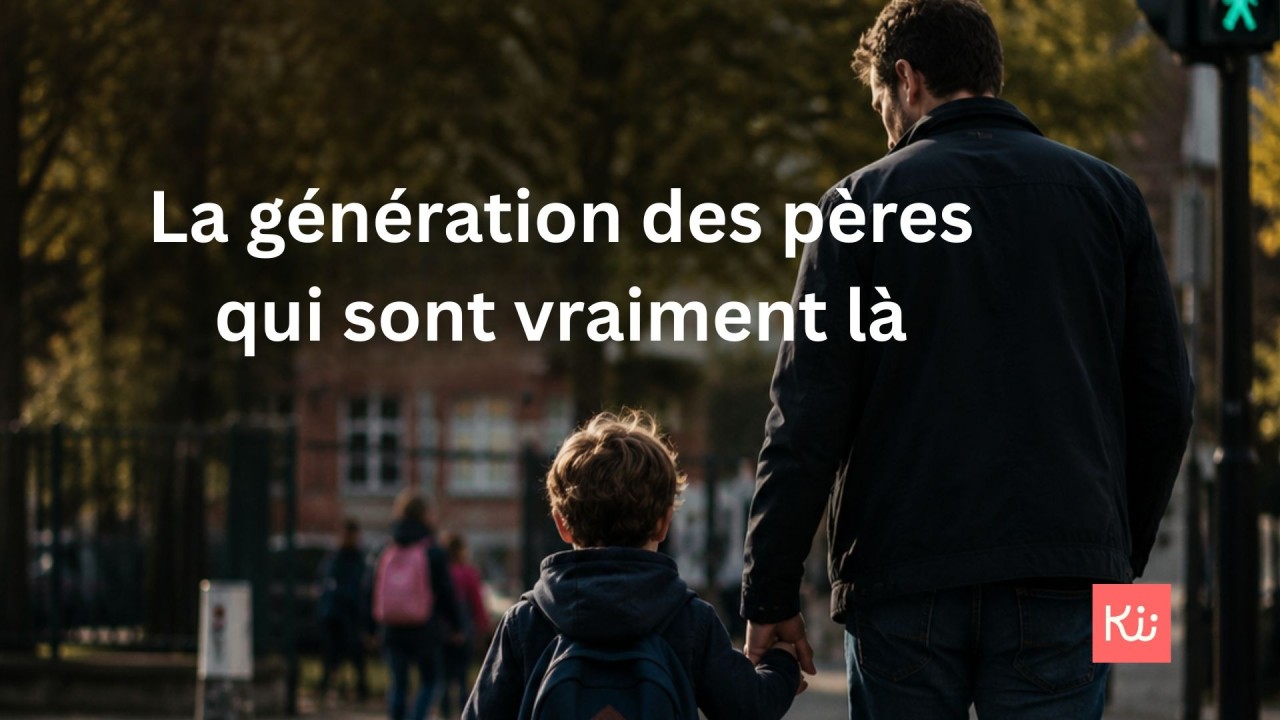
If you are a father in your thirties or forties, take a few seconds to go back to your own childhood.
Picture your father when you were the age your children are now. Try to remember an entirely ordinary week. Who got you ready in the morning? Who knew what had to go into your school bag? Who knew your teacher's name, made the doctor's appointments, took you to your activities, or noticed when something was wrong at school?
This is not about judging our fathers, nor about reinterpreting our childhood through today's expectations. Family roles, social norms and what was expected of a father were simply different.
Your father may well have been very present. He played with you, took you to sport on Saturdays, or helped you learn to ride a bike. And he probably worked hard for his family.
But for many men of that generation, a large part of children's daily lives was mainly carried by their mother.
Now look at your own week.
There is work, of course, but also the school run, meals, homework, appointments, Wednesday activities, messages from school, clothes to lay out for tomorrow, bedtime stories, and those conversations that sometimes begin at exactly the moment you thought you might finally go to bed.
The difference between the two generations is not just an impression. In France, it shows up in the statistics too.
In 25 years, French fathers' parental time has almost doubled
Insee's Time Use surveys make it possible to look very concretely at how people in France spend their days.
Among men living with at least one child under eighteen, the time devoted each day to parental activities rose on average from 22 minutes in 1985 to 41 minutes in 2010.
An increase of nearly 86% in twenty-five years.
What is particularly interesting is how that additional time is used. Work by Insee and Ined shows an increase in time spent caring for children, in the travel their daily lives require, and in play. The rise is especially marked with young children.
France's detailed time-use data unfortunately dates from 2010. Insee is currently running a new national Time Use survey for 2025-2026. It will let us measure what happened over the fifteen years that followed.
But the trend observed in France matches what has been found in several other countries: fathers spend far more time looking after their children directly than previous generations did.
A different way of being a father
For our fathers' generation, paternal responsibility was strongly bound up with work, protection and the family's material security.
Those responsibilities still exist. But children's daily lives now occupy a far larger place in the very definition of fatherhood.
A father is more involved in school, medical appointments, meals, after-school activities and the organisation of the week. He also takes a greater part in the emotional side of childhood: the worries, the friendships, the conflicts, and those moments when a child simply needs to talk.
This obviously does not mean that parental responsibilities have become evenly shared. Women continue to carry a larger share of parental and domestic work in France.
But something has clearly shifted. Fathers devote more time to their children and hold a larger place in their daily lives.
For separated fathers, this shift takes on another dimension
We still sometimes carry the image of the separated father who sees his children every other weekend. That reality exists, but it no longer describes families after separation on its own.
In France, in 2023, 14% of children whose parents were separated lived in shared residence, spending as much time with each of their parents. That proportion has risen by more than two points since 2020.
Among nine-year-olds, it reaches 17%.
And that profoundly changes the experience of fatherhood after a separation.
When the children arrive at their father's home for several days, what it takes is simply to run a household with children in it.
The morning sometimes begins with a child who refuses to get out of bed and a shoe that has mysteriously disappeared. You have to get to school on time, work, answer messages, do the shopping, collect the children, make dinner, supervise homework, and remember what has to go to school tomorrow.
You also have to handle the tiredness, the arguments, the small sorrows, and the evenings when nobody wants to go to bed.
It is in that accumulation of ordinary things that the relationship is built.
For some men, separation can even make this daily responsibility more visible. During the days the children are with them, they become responsible for the whole of their everyday lives.
They do not simply spend time with their children. They live with them.
What our children will remember
It is hard to know how today's children will tell the story of their childhood in twenty or thirty years.
They will certainly remember some big moments: a trip, a birthday, a particular holiday. But a childhood is made mostly of far more ordinary things.
The hundreds of car journeys. A meal Dad often made. His presence at the edge of the pitch. A joke repeated far too often. A conversation on the way home from school. A story told at bedtime.
That is perhaps where the change in the time fathers spend with their children becomes far more interesting than a statistic. And when your children are in their thirties or forties in turn, and are asked to think about their father, this may be what they remember above all:
all that ordinary time spent together.
Sources: Insee, Time Use surveys; Ined, research on the evolution of parental time; Insee, 2023 data on children of separated parents and shared residence; Insee, Time Use survey 2025-2026.